The Replication Network
Furthering the Practice of Replication in Economics
ETIENNE LEBEL: Introducing “CurateScience.Org”
It is my pleasure to introduce Curate Science (http://CurateScience.org) to The Replication Network. Curate Science is a web application that aims to facilitate and incentivize the curation and verification of empirical results in the social sciences (initial focus in Psychology). Science is the most successful approach to generating cumulative knowledge about how our world works. This success stems from a key activity, independent verification, which maximizes the likelihood of detecting errors, hence maximizing the reliability and validity of empirical results. The current academic incentive structure, however, does not reward verification and so verification rarely occurs and when it does, is highly difficult and inefficient. Curate Science aims to help change this by facilitating the verification of empirical results (pre- and post-publication) in terms of (1) replicability of findings in independent samples and (2) reproducibility of results from the underlying raw data.
The platform facilitates replicability by enabling users to link replications directly to their original studies, with corresponding real-time updating of meta-analytic effect size estimates and forest plots of replications (see Figure below).[1] The platform aims to incentivize verification in terms of replicability by easily allowing users to invite others to replicate one’s work and also by providing a professional credit system that explicitly acknowledges replicators’ hard work commensurate to the “expensiveness” of the executed replication.
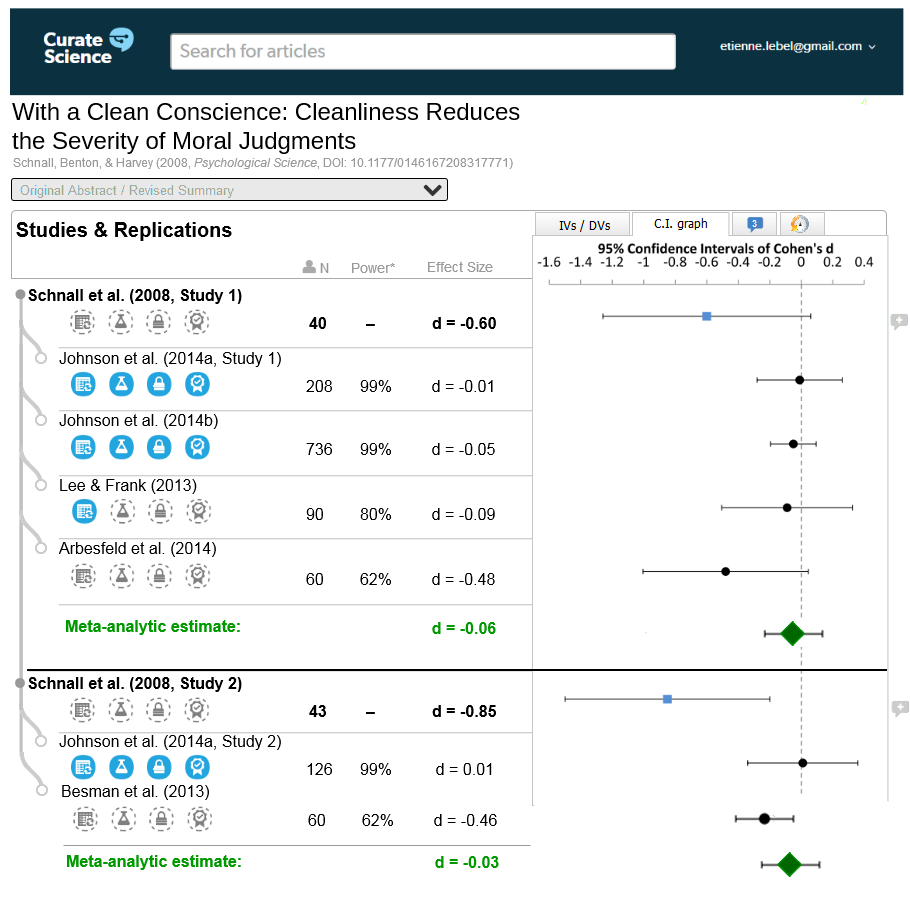
The platform facilitates reproducibility by enabling researchers to check and endorse the analytic reproducibility of each other’s empirical results via data analyses executed within their web browser for studies with open data. The platform will visually acknowledge the endorser via a professional credit system to incentivize researchers to verify the reproducibility of each other’s results, when direct replications are not feasible or too expensive to execute.
The platform allows curation of study information, which is required for independent verification in terms of replicability and reproducibility. However, the platform also features additional curation activities including “revised community abstracts” (crowd-sourced abstracts summarizing how follow-up research has qualified original findings, e.g., boundary conditions) and curation of organic and external post-publication peer-review commentaries.
Our vision
Curate Science’s vision for the future of academic science is one where verification is routinely and easily done in the cloud, and in which appropriate professional credit is given to researchers who engage in such verification activities (i.e., verifying replicability and reproducibility of empirical results, and post-publication peer review). We foresee a future where one can easily look up important articles in one’s field to see the current status of findings via revised community abstracts (a la Wikipedia). This will maximize the impact and value of research in terms of re-use by other researchers (e.g., help unearth new insights from different theoretical perspectives), and hence accelerate theoretical progress and innovation for the benefit of society.
Current activities
Our current activities include the curation of articles and replications in psychology, which includes identifying professors who will get PhD students to curate and link replications for seminal studies covered in their seminar classes. We’re also busy in terms of advocacy and canvassing: I’m currently on a 3-month USA-Europe tour presenting Curate Science and getting concrete feedback from over 10 university psychology departments. Finally, and crucially, we’re particularly busy with software development and refinement of the website’s user-interface to improve the usability and user experience of the website (e.g., fixing bugs, implementing refinements, and improvements). To check out the early beta version of our website, please go here: http://www.curatescience.org/beta#/login
[1] In the future, users will also be able to create their own meta-analyses in the cloud for generalizability studies (a.k.a “conceptual replications”), which other users will easily be able to add to/update via crowd-sourcing.
REPLICATE THIS: Do Dark-Skinned Footballers Get Given Red Cards More Often Than Light-Skinned Ones?
FROM THE ARTICLE: “It sounds like an easy question for any half-competent scientist to answer. Do dark-skinned footballers get given red cards more often than light-skinned ones? But, as RAPHAEL SILBERZAHN …and ERIC UHLMANN … illustrate in this week’s Nature, it is not. The answer depends on whom you ask, and the methods they use.” To read more, click here.
Could The Best Way to Find the Truth Be To Hide It?
In a recent opinion piece in the journal Nature, ROBERT MACCOUN and SAUL PERLMUTTER argue that “blind analysis” techniques, originally developed in particle physics, could be useful for the social sciences as well. For example, in testing whether X affects Y, the data would be manipulated by a third party in such a way that the researcher would not be able to determine the true relationship. Instead, the researcher would develop the data and estimation procedures that they judged to be most likely to produce an accurate outcome. Only after the researcher signed off on the data and estimation procedures, would they be allowed to see the result. To read more, click here.
BENJAMIN WOOD and ANNETTE BROWN: What 3ie Is Doing in the Replication Business
What’s the International Initiative for Impact Evaluation (3ie) doing in the replication business? 3ie is mostly known in the development community as a funder of impact evaluations and systematic reviews. But our leadership always envisioned a role for replication research within 3ie’s mandate to provide high quality evidence for policymaking. We designed 3ie’s replication programme to encourage internal replication studies of influential, innovative, or controversial development-related impact evaluations. Through two rounds of replication windows we’ve funded 10 replication studies to date, including the highly discussed replication research around deworming treatments in Kenya (for a related news item in TRN, click here). So here’s what 3ie is doing in the replication business.
Our processes are designed to address common criticisms of replication research (with this blog borrowing from a forthcoming paper we’re writing about it). Selection of replication-eligible studies is fraught with insinuations of improper selection, with replication researchers supposedly only choosing to replicate studies they feel confident they can disprove. We address that criticism by creating different eligibility mechanisms, such as choosing studies based on a crowdsourced Candidate Studies List and gathering a committee of experts to judge the policy relevance of each replication study proposal.
One of the biggest concerns regarding replication research is researcher incentives. If bias exists for original authors to discover a new result, it can also exist for replication researchers to disprove the established result. To address this concern, we require all replication researchers to post replication plans, which allow readers to know how the researchers intended to undertake their replication study before starting the research. Ideally all robustness tests conducted in the replication paper will be publicly pre-specified in these replication plans.
In an attempt to further defuse replication tensions, we encourage engagement between the replication researchers and the original authors. We require 3ie-funded replication researchers to include a “pure replication,” and to share these results early in the replication process. In the pure replication, the researchers attempt to reproduce the published results using the same data and methods as in the publication. We then require these replication researchers to share their findings with the original authors before completing their study, giving the original authors the opportunity to reply to the direct reproduction of their work before any results are finalized.
Original authors are understandably sensitive to replication researchers who (in their opinion) solely aim to discredit their work. 3ie’s replication process includes multiple rounds of internal and external referring, including reviews of replication plans, pure replications, and draft final replication reports (see our peer reviewing replication research blog for more detail).
Finally, replication researchers are concerned that they will spend a significant amount of time conducting their study and then have no place to publish it. And original authors are worried that they won’t have an opportunity to directly reply to the replication study. While we cannot guarantee publications, we created 3ie’s Replication Paper Series (RPS) to partially address both of these concerns. The RPS provides an outlet for the replicating researchers to publish their work, and for original authors to respond to it. We view the RPS as a repository of replication research, including confirmatory studies that might struggle to find space in a journal.
If you’re interested in replication research, here are a few ways to get involved with 3ie’s replication programme:
– We’re planning another replication window. Send us the titles of recently published policy relevant development impact evaluations papers that you think should be considered for future replication to replication@3eimpact.org.
– Apply for a replication award when we open our next window.
– Volunteer to serve as an external reviewer of replication research.
– Submit your replication paper, even if it wasn’t funded by 3ie, to our RPS (here are the instructions).
SVEN VLAEMINCK: Data Policies at Economics Journals: Theory and Practice
In economic sciences, empirically-based studies have become increasingly important: According to Hamermesh (2012), the number of contributions to journals in which authors utilized self-collected or externally produced datasets for statistical analyses have massively increased in the course of the last decades.
With the growing relevance of publications based on empirical research, new questions and challenges emerge: Issues like integrating research data and scripts to run a data model in the broader context of a published article to foster replicable research and validation of scientific results are becoming increasingly important for both researchers and editors of scholarly journals.
Especially for a scientific discipline like economics, the effects of flawed research might have a huge impact on society, as the prominent debate of Reinhart’s and Rogoff’s “Growth in a time of debt” (2010) illustrated. Their paper attracted much attention and the results were cited by US vice presidential candidate Paul Ryan and EU monetary affairs commissioner Olli Rehn to justify austerity policy.
But when Rogoff and Reinhart provided the Excel-sheet of their calculations for teaching purposes to a student in 2013, this student, Thomas Herndon, was not able to replicate the results of the paper. Furthermore, he discovered that the Excel-sheet contained faulty calculations and selectively omitted data, which casted massive doubts on Reinhart’s and Rogoff’s findings.
Despite the fact, that the paper of Rogoff and Reinhart has been published in the American Economic Review (AER), a journal having a strict data availability policy, the paper of the two American researchers has been exempted from this policy.
Therefore one could ask how journals in economics and business studies generally handle the challenges associated with empirically-based research. At least in theory, journals should serve as a quality assurance for economic research. On these grounds, peer-review was established to ensure a high quality of published research. But apparently, peer-review does not include the data appendices or other materials associated with empirically-based research: According to the US-economist B.D. McCullough, journals often fail to ensure the robustness of published results. After investigating the data archives of some economic journals, he concluded: „Despite claims that economics is a science, no applied economics journal can demonstrate that the results published in its pages are replicable, i.e., that there exist data and code that can reproduce the published results. No theory journal would dream of publishing a result (theorem) without a demonstration (proof) that the reader can trust the result.” (McCullough, 2009)
To analyse how journals in economics and business studies deal with the challenge of reproducible research since the new decade, in 2010 we applied for funding from the German Research Foundation (DFG) for a project called “European Data Watch Extended – EDaWaX“. EDaWaX has several goals: The main objective of the project is to develop a software application for editors of social sciences’ journals. This software facilitates the management of publication-related research data. To gather some of the functional requirements for the development of the application, we analysed the number and specifications of existing data policies of economics journals for the first time in 2011. In 2014 we expanded our study. In our recent paper, we analysed the data policies of scholarly journals available in a sample of 346 journals. Many of them are among the top-journals of the profession. In contrast to our study in 2011, we also included a big share of journals in business studies to compare both branches of economic research.
Especially for economics journals we are able to state that things are changing slowly but steady: More than fourth of all economics journals in our sample are equipped with more or less functional data policies. While some journals pay lip-service to reproducible research, others effectively enforce their data policy.
In our paper we summarise the findings of this empirical study. We regard both the extent and the quality of journals’ data policies, which should facilitate replications of published empirical research. The paper presents some characteristics of journals equipped with data policies and gives some recommendations for suitable data policies in economics and business sciences journals. In addition, we also evaluate the journals’ data archives to roughly estimate whether these journals enforce data availability.
References:
Hamermesh, D.S. (2012), Six Decades of Top Economics Publishing: Who and How?, National Bureau of Economic Research, Working Paper 18635. Retrieved from http://www.peri.umass.edu/236/hash/31e2ff374b6377b2ddec04deaa6388b1/publication/566.
Herndon, T.; Ash, M. & Pollin R. (2013), Does High Public Debt Consistently Stifle Economic Growth? A Critique of Reinhart and Rogoff, Political Economy Research Institute. Retrieved from: http://www.peri.umass.edu/fileadmin/pdf/working_papers/working_papers_301-350/WP322.pdf.
Krugman, P. (2013), The Excel Depression, The New York Times, April 19 2013, p. A31. Retrieved from http://www.nytimes.com/2013/04/19/opinion/krugman-the-excel-depression.html?_r=4.
McCullough, B.D. (2009): Open Access Economics Journals and the Market for Reproducible Economic Research. Economic Analysis and Policy 39, 1, pp. 117-126.
Rehn, O. (2013), Letter to ECOFIN Ministers – ARES (2013)185796, February 13 2013, Retrieved from: http://ec.europa.eu/archives/commission_2010-2014/rehn/documents/cab20130213_en.pdf.
Reinhart, C.M. & Rogoff, K.S. (2010), Growth in a Time of Debt, American Economic Review 100, 2, 573–578. Retrieved from https://www.aeaweb.org/articles.php?doi=10.1257/aer.100.2.573.
Ryan, P. (2013), The Path to Prosperity: A Blueprint for American Renewal. Fiscal Year 2013 Budget Resolution, House Budget Committee. Retrieved from http://budget.house.gov/uploadedfiles/pathtoprosperity2013.pdf.
The American Economic Review (2005), Data Availability Policy. Retrieved from: https://www.aeaweb.org/aer/data.php.
Vlaeminck, S. / Herrmann L.K. (2015), Data policies and data archives: A new paradigm for academic publishing in economic sciences? In: Schmidt, B. & Dobreva, M. (Eds.), New Avenues for Electronic Publishing in the Age of Infinite Collections and Citizen Science: Scale, Openness and Trust. Proceedings of the 19th International Conference on Electronic Publishing, September 2015. Retrieved from doi:10.3233/978-1-61499-562-3-145.
Is Economic Research Replicable? Study Concludes: “Usually Not”
In a recent working paper, authors ANDREW CHANG and PHILLIP LI examined 60 published, empirical papers in 13 economics journals to determine whether the research could be replicated. Less than half of the papers could be replicated, even with help from the authors. The main reason that articles could not replicated was that sufficient data and code were not provided. The paper concludes with recommendations for how to improve the state of replicability in economics. To read more, click here.
Science Journal Argues that Requiring Transparency Inhibits “Creativity and Novelty”. Really?
In a recent editorial, the journal Epidemiology argues that committing to a set of standards known at the Transparency and Openness Promotion (TOP) guidelines would, among other things, inhibit “creativity and novelty.” Instead, the journal says, “We intend to soon ask authors of each new submission to explain whether and how these materials might be made available.” To read the journal’s full editorial, click here. To learn more about the TOP guidelines, click here. (H/t to the blog Political Science Replication for this item.)
JOOP HARTOG: Yes, the tide is turning!
In 1981 I was appointed as a professor of economics at the University of Amsterdam. One of my colleagues was Joop Klant, professor of economic methodology. When he retired, in 1986, at the farewell dinner, he reminded us of his opportunity cost: we received a copy of his novel De fiets (The bicycle), a booklet that had brought him literary fame in his youth. He signed my copy with the encouragement: “Test, test, test, Hartog: never stop”. Yes, we shared a belief in the Popperian assignment and I have been trying to test theory whenever I could. In fact, the paper I am now working on is an empirical test of the theory that employers safeguard young graduates from wage reduction when their productivity turns out below standard (the present verdict is: reject!).
In 1994, my friend Jules Theeuwes and I launched the journal Labour Economics. We wanted a balanced mix of theory and empirical work and we opened a separate section for Replications, with a separate editor. As replication submissions were barely forthcoming (one paper in 3 years), we decided to beat the drum. We were firm believers. “The basic premise of econometric research is the existence of stable parameter values in equations that relate economic variables. Yet, we do not have a great deal of information about parameter values and their empirical distributions”, we wrote in 1997 as introduction to a set of invited papers on replication (Labour Economics, 4(2), 99). We guaranteed publication of replication studies, provided they would meet some mild conditions (aim to replicate key findings of an original article in a leading journal, and contain no methodological flaws).
To our regret, we never got a single submission. We understood the reason quite well. Replication does not lead to academic prestige. There are some famous cases of replications that failed to reproduce the original findings (Harberger’s tax on capital, the Journal of Money, Credit and Banking Project, see our Labour Economics introduction), but basically, the profession and in particular journal editors, were not interested. But the times, they are a’changing.
Interest in the reliability and credibility of empirical work has been mounting. For nine years, I have been a member of LOWI, a national board for research integrity founded by Dutch universities and The Netherlands Academy of Sciences. It’s a board of appeal on university rulings on research integrity. When we started, a decade ago, we got a few cases annually. In 2014 the board got 24 cases, generally much more serious than initially, with heavy impact on the accused. In The Netherlands we experienced some spectacular cases of data fraud (not in economics though) and awareness of the ofen very shaky basis of econometric results has strongly increased. The dangers of an emphasis on originality, on new methods, new models, new approaches, rather than on the painstaking patient search for reliable, reproducable results are now clearly appreciated. Data must be made easily available. I remember a phrase that struck me long ago: “Often, a researcher’s mind is more fruitful than his database”. Data transparancy and a new attitude should change that.
Some time ago, it occurred to me that professional organisations or journals should create a replication archive. I mentioned that, visiting Waikato University, to Jacques Poot, who told me: my dear friend, that exists! An excellent initiative. It proves again that the new day starts in New Zealand: that ‘s where the sun first rises.
Here’s evidence on my sincerity:
-
Arulampalam, J. Hartog, T. MaCurdy and J.Theeuwes (1997), Replication and re-analysis, Labour Economics, 4(2), pp. 99-105
-
Cabral Vieira, L. Diaz Serrano, J. Hartog and E. Plug (2003), Risk compensation in wages: a replication, Empirical Economics, 28, pp. 639-647
-
Mazza, H. van Ophem and J. Hartog (2013), Unobserved heterogeneity and risk in wage variance: Does more schooling reduce earnings risk? Labour Economics, 24 (), 323-338
-
Budria, L. Diaz Serrano, A. Ferrer and J. Hartog (2013), Risk Attitude and Wage Growth, Replicating Shaw (1996), Empirical Economics, 44 (2), 981-1004

 The Replication Network
You must be logged in to post a comment.