What’s the true effect size? That’s my bottom line question when doing a study or reading a paper. I don’t expect an exact answer, of course. What I want is a probability distribution telling where the true effect size probably lies. I used to think confidence intervals answered this question, but they don’t except under artificial conditions. A better answer comes from Bayes’s formula. But beware of the devil in the priors.
Confidence intervals, like other standard methods such as the t-test, imagine we’re repeating a study an infinite number of times, drawing a different sample each time from the same population. That seems unnatural for basic, exploratory research, where the usual practice is to run a study once (or maybe twice for confirmation).
As I looked for a general way to estimate true effect size from studies done once, I fell into Bayesian analysis. Much to my surprise, this proved to be simple and intuitive. The code for the core Bayesian analysis (available here) is simple, too: just a few lines of R.
The main drawback is the answer depends on your prior expectation. Upon reflection, this drawback may really be a strength, because it forces you to articulate key assumptions.
Being a programmer, I always start with simulation when learning a new statistical method. I model the scenario as a two stage random process. The first stage selects a population (aka “true”) effect size, dpop, from a distribution; the second carries out a study with that population effect size yielding an observed effect size, dobs. The studies are simple two group difference-of-mean studies with equal sample size and standard deviation, and the effect size statistic is standardized difference (aka Cohen’s d).
I record dpop and dobs from each simulation producing a table showing which dpops give rise to which dobss. Then I pick a target value for dobs, say 0.5, and limit the table to rows where dobs is near 0.5. The distribution of dpop from this subset is the answer to my question. In Bayesian-speak, the first-stage distribution is the prior, and the final distribution is the posterior.
Now for the cool bit. The Bayesian approach lets us pick a prior that represents our assumptions about the distribution of effect sizes in our research field. From what I read in the blogosphere, the typical population effect size in social science research is 0.3. I model this as a normal distribution with mean=0.3 and small standard deviation, 0.1. I also do simlulations with a bigger prior, mean=0.7, to illustrate the impact of the choice.
Figures 1a-d show the results for small and large samples (n=10 or 200) and small and big priors for dobs=0.5. Each figure shows a histogram of simulated data, the prior and posterior distributions (blue and red curves), the medians of the two distributions (blue and red dashed vertical lines), and dobs (gray dashed vertical line).
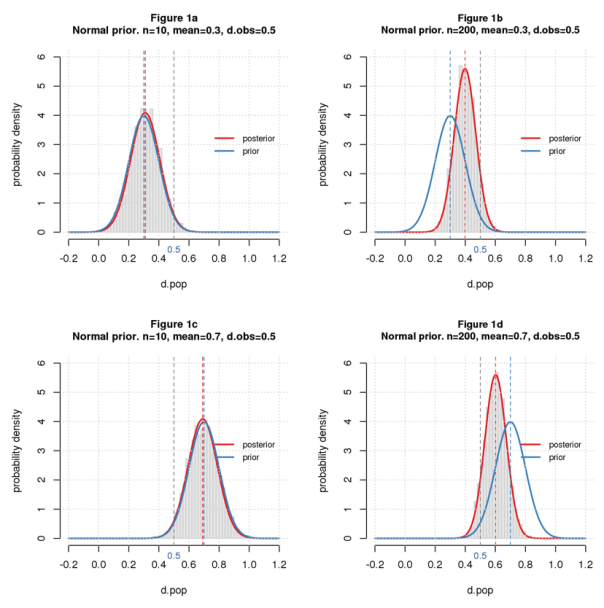
The posteriors and histograms match pretty well, indicating my software works. For n=10 (left column), the posterior is almost identical to the prior, while for n=200 (right column), it’s shifted toward the observed. It’s a tug-of-war: for small samples, the prior wins, while for large samples, the data is stronger and keeps the posterior closer to the observation. The small prior (top row) pulls the posterior down; the big one (bottom row) pushes it up. Completely intuitive.
But wait. I forgot an important detail: some of the problems we study are “false” (“satisfy the null”). No worries. I model the null effect sizes as normal with mean=0 and very small standard deviation, 0.05, and the totality of effect sizes as a mixture of this distribution and the “true” ones as above. To complete the model, I have to specify the proportion of true vs. null problems. To illustrate the impact, I use 25% true for the small prior and 75% for the big one.
Figures 2a-d show the results.
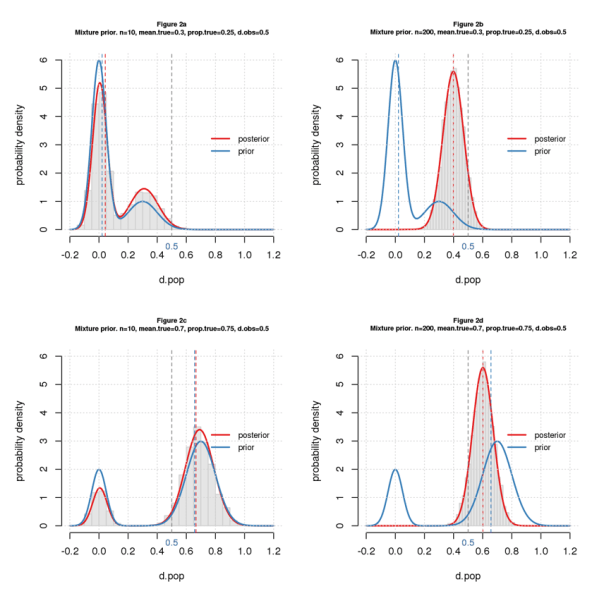
The priors have two peaks, reflecting the two classes. With 25% true (top row), the false peak is tall and the true peak short; with 75% true (bottom row), it’s the opposite though not as extreme. For small samples (left column), the posterior also has two peaks, indicating that the data does a poor job of distinguishing true from null cases. For big samples (right column), the posterior has a single peak, which is clearly in true territory. As in Figure 1, the small prior (top row) pulls the result down, while the bigger one (bottom row) pushes it up. Again completely intuitive.
What’s not to like?
The devil is in the priors. Small priors yield small answers; big priors yield bigger ones. Assumptions about the proportion of true vs. null problems amplify the impact. Reasonable scientists might choose different priors making it hard to compare results across studies. Unscrupulous scientists may choose priors that make their answers look better, akin to p-hacking.
For this elegant method to become the norm, something has to be done about the priors. Perhaps research communities could adopt standard priors for specific types of studies. Maybe we can use data from reproducibility projects to inform these choices. It seems technically feasible. No doubt I’ve missed some important details, but this seems a promising way to move beyond p-values.
COMMENTS PLEASE!
Nat Goodman is a retired computer scientist living in Seattle Washington. His working years were split between mainstream CS and bioinformatics and orthogonally between academia and industry. As a retiree, he’s working on whatever interests him, stopping from time-to-time to write papers and posts on aspects that might interest others.
[Excerpts taken from the article, “A journal club to fix science” by Amy Orben, published in Nature]
“If science had generations, mine would not be defined by war or Woodstock, but by reproducibility and open science….Early-career researchers do not need to wait passively for coveted improvements. We can create communities and push for bottom-up change. ReproducibiliTea is one way to do this.”
“Sam Parsons, Sophia Crüwell and I (all trainees) started this grass-roots journal club in early 2018, at the experimental-psychology department at the University of Oxford, UK. We hoped to promote a stronger open-science community and more prominent conversations about reproducibility. The initiative soon spread, and is now active at more than 27 universities in 8 countries.”
“During each meeting, a scientific paper lays the groundwork for a conversation. Concerns vary from field to field and institution to institution, so each club focuses on aspects of scientific methods and systems that concern them most. Topics for my group ranged from discussions on replicability (Open Science Collaboration Science 349, aac4716; 2015), to debates about open-access publishing (J. P. Tennant et al. F1000 Res. 5, 632; 2016), the problems of analytical flexibility (J. P. Simmons et al. Psychol. Sci. 22, 1359–1366; 2011) and the potential of Registered Reports, a publication format in which papers are reviewed primarily on the research question and protocol, before results are known (C. D. Chambers Cortex 49, 609–610; 2013).”
“To launch their own ReproducibiliTea group, motivated researchers need only to select some articles and set a time and a place. No minimum group size or meeting frequency is required. They will then join a community of ReproducibiliTea journal clubs that continually discuss improvements and support each other. (For more information, see https://reproducibilitea.org/.)”
To read the article, click here.
[Excerpts taken from the article “Are confidence intervals better termed ‘uncertainty intervals’?” by Andrew Gelman and Sander Greenland, published in the BMJ.]
Are confidence intervals better termed “uncertainty intervals?”
Yes—Andrew Gelman
“Confidence intervals can be a useful summary in model based inference. But the term should be “uncertainty interval,” not “confidence interval”…”
“Officially, all that can be interpreted are the long term average properties of the procedure that’s used to construct the interval, but people tend to interpret each interval implicitly in a bayesian way—that is, by acting as though there’s a 95% probability that any given interval contains the true value.”
“Using confidence intervals to rule out zero (or other parameter values) involves all of the well known problems of significance testing. So, rather than constructing this convoluted thing called a confidence procedure, which is defined to have certain properties on average but can’t generally be interpreted for individual cases, I prefer to aim for an uncertainty interval, using the most appropriate statistical methods to get there.”
“Let’s use the term “uncertainty interval” instead of “confidence interval.” The uncertainty interval tells us how much uncertainty we have.”
No—Sander Greenland
“The label “95% confidence interval” evokes the idea that we should invest the interval with 95/5 (19:1) betting odds that the observed interval contains the true value…”
“…the 95% is overconfident because it takes no account of procedural problems and model uncertainties that should reduce confidence in statistical results. Those possibilities include uncontrolled confounding, selection bias, measurement error, unaccounted-for model selection, and outright data corruption.”
“…no conventional interval adequately accounts for procedural problems that afflict data generation or for uncertainties about the statistical assumptions.”
“Nonetheless, all values in a conventional 95% interval can be described as highly compatible with data under the background statistical assumptions, in the very narrow sense of having P>0.05 under those assumptions.”
“In equivalent terms: given any value in the interval and the background assumptions, the data should not seem very surprising. This leads to the intentionally modest term “compatibility interval” as a replacement for ‘confidence interval.'”
“In summary, both “confidence interval” and “uncertainty interval” are deceptive terms, for they insinuate that we have achieved valid quantification of confidence or uncertainty despite omitting important uncertainty sources.
“Replacing “significance” and “confidence” labels with “compatibility” is a simple step to encourage honest reporting of how little we can confidently conclude from our data.”
To read the full article, click here. (NOTE: Article is behind a paywall.)
[Excerpts taken from the article “Laypeople Can Predict Which Social Science Studies Replicate” by Suzanne Hoogeveen, Alexandra Sarafoglou, and Eric-Jan Wagenmakers, posted at PsyArXiv Preprints]
“…we assess the extent to which a finding’s replication success relates to its intuitive plausibility. Each of 27 high-profile social science findings was evaluated by 233 people without a PhD in psychology. Results showed that these laypeople predicted replication success with above-chance performance (i.e., 58%). In addition, when laypeople were informed about the strength of evidence from the original studies, this boosted their prediction performance to 67%.”
“Participants were presented with 27 studies, a subset of the studies included in the Social Sciences Replication Project…and the Many Labs 2 Project.”
“For each study, participants read a short description of the research question, its operationalization, and the key finding…In the Description Only condition, solely the descriptive texts were provided; in the Description Plus Evidence condition, the Bayes factor and its verbal interpretation (e.g., “moderate evidence”) for the original study were added to the descriptions.”
“After the instructions, participants…indicated whether they believed that this study would replicate or not (yes / no), and expressed their confidence in their decision on a slider ranging from 0 to 100.”
“Figure 1 displays participants’ confidence ratings concerning the replicability of each of the 27 included studies, ordered according to the averaged confidence score.”

“Positive ratings reflect confidence in replicability, and negative ratings reflect confidence in non-replicability, with −100 denoting extreme confidence that the effect would fail to replicate. Note that these data are aggregated across the Description Only and the Description Plus Evidence condition.”
“The top ten rows indicate studies for which laypeople showed relatively high agreement that the associated studies would replicate. Out of these ten studies, nine replicated and only one did not (i.e., the study by Anderson, Kraus, Galinsky, & Keltner, 2012; note that light-grey indicates a successful replication, and dark-grey indicates a failed replication).”
“The bottom four rows indicate studies for which laypeople showed relatively high agreement that the associated studies would fail to replicate. Consistent with laypeople’s predictions, none of these four studies replicated.”
“For the remaining 13 studies in the middle rows, the group response was relatively ambiguous, as reflected by a bimodal density that is roughly equally distributed between the negative and positive end of the scale. Out of these 13 studies, five replicated successfully and eight failed to replicate successfully.”
“Overall, Figure 1 provides a compelling demonstration that laypeople are able to predict whether or not high-profile social science findings will replicate successfully.”
“…the relative ordering of laypeople’s confidence in replicability for a given set of studies may provide estimations of the relative probabilities of replication success.”
“If a replicator’s goal is to purge the literature of unreliable effects, he or she may start by conducting replications of the studies for which replication failure is predicted by naive forecasters.”
“Alternatively, if the goal is to clarify the reliability of studies for which replication outcomes are most uncertain, one could select studies for which the distribution of the expected replicability is characterized by a bi-modal shape.”
“As such, prediction surveys may serve as ‘decision surveys’, instrumental in the selection stage of replication research (cf. Dreber et al., 2015). These informed decisions could not only benefit the replicator, but also optimize the distribution of funds and resources for replication projects.”
To read the article, click here.
[Excerpts taken from the article “New Journal Focused on Reproducibility” by Colleen Flaherty, published at insidehighered.com]
“Cambridge University Press is launching a new open-access journal to help address science’s reproducibility issues and glacial peer-review timelines. Experimental Results, announced today, gives researchers a “place to publish valid, standalone experimental results, regardless of whether those results are novel, inconclusive, negative or supplementary to other published work,” according to the press. It will also publish work about attempts to reproduce previously published experiments.”
[Excerpts taken from the article, “Artificial Intelligence Confronts a ‘Reproducibility’ Crisis’” by Gregory Barber, published at Wired.com]
“A few years ago, Joelle Pineau, a computer science professor at McGill, was helping her students design a new algorithm when they fell into a rut. …Pineau’s students hoped to improve on another lab’s system. But first they had to rebuild it, and their design, for reasons unknown, was falling short of its promised results. Until, that is, the students tried some “creative manipulations” that didn’t appear in the other lab’s paper. Lo and behold, the system began performing as advertised.”
“The lucky break was a symptom of a troubling trend, according to Pineau. Neural networks, the technique that’s given us Go-mastering bots and text generators that craft classical Chinese poetry, are often called black boxes because of the mysteries of how they work. Getting them to perform well can be like an art, involving subtle tweaks that go unreported in publications. The networks also are growing larger and more complex, with huge data sets and massive computing arrays that make replicating and studying those models expensive, if not impossible for all but the best-funded labs.”
“Pineau is trying to change the standards.”
To read the article, click here.
Replication markets are prediction markets run in conjunction with systematic replication projects. We conducted such markets for the Replication Project: Psychology (RPP), Experimental Economics Replication Project (EERP), Social Science Replication Project (SSRP) and the Many Labs 2 Project (ML2). The participants in these markets trade ‘bets’ on the outcome of replications. Through the pricing of these bets they generate and negotiate quantitative forecasts for the replication results.
This post has three objectives: 1 – Advertise a new replication market project; 2 – Explain why it is useful to run prediction markets on replications; 3 – Discuss caveats with relying on binary interpretations of replication results.
Advertisement
As part of DARPA SCORE, we are currently recruiting participants for a new replication market project. As in our past projects, there is a bunch of studies that are going to be replicated, and we’d love to know how well our participants can forecast the outcome of these replications. There are some important differences to our past markets.
The first major difference is scale: in past replication markets, the number of studies we elicited forecasts for was in the order of 20. For SCORE, our forecasted studies will total 3,000.
Of course, nobody is going to replicate 3,000 studies. Rather, about 100 are selected for replication. We are not informed which ones. We designed our markets to generate forecasts for all 3,000 studies, but only bets for those 100 forecasts that are validated will be paid out.
Second, given the scale, we do the forecasting in monthly rounds over about one year. We will have 10 rounds, each on 300 studies, and 2 types of incentives for our participants.
Each round, prizes are distributed for survey responses to those who are estimated (using a peer assessment method) to be most accurate. In addition, bets in the market are paid out once the 100 replications have been conducted, and the replication outcomes are released. The total prize pool is USD 100,000+. Currently, we have more than 600 active participants. If interested, have a look / sign up at predict.replicationmarkets.com!
Why are we doing this?
We started with prediction markets to see if researchers have an idea about which findings are replicable, and which ones are not; and if prediction markets can aggregate this information into accurate forecasts.
We acknowledge that “an idea about which findings are reliable” is incredibly vague. A more accurate description could involve Bayesian subjective priors on the replicated hypotheses, beliefs on distributions of effect sizes, and considerations about the appropriateness of the instrumentalization. But we’re not there yet.
Our results are encouraging: in our past replication markets, the forecasted probabilities fit very well to the observed outcomes. In these projects, we observed the outcomes for (nearly) all forecasted replications. The value of forecasting replications may therefore not be so much the forecast itself, but the proof-of-principle that the outcome of replications can be forecasted.
In the new SCORE project, this will be different. Rather than just providing a proof-of-principle, there are approximately 2,900 studies that are not selected for replication. For those studies, our forecasts will provide valuable pieces of information on the studies’ credibility.
Binary interpretations
In our replication markets, we typically use a binary criterium to settle the bets: whether the replication result is statistically significant and the effect is in the same direction as in the original study.
The use of such dichotomies has been criticized – have a look at the “dichotomania” thread in Andrew Gelman’s blog – not only for prediction markets, but also for the summaries of large-scale replications (“X out of Y studies replicated”) and for the interpretation of research findings in general (p<0.05 = evidence; p>0.05 = lack of evidence).
Dichotomies are simplifications, and as such entail a loss of information. Publications on large-scale replication projects therefore offer a wealth of additional information, starting from additional binary criteria down to every single replication effect size and how it relates to the original effect.
For prediction markets, the reason for using the above binary criterium is that elicitation for continuous outcomes appears to be much harder than for binary outcomes. We would love to elicit and aggregate the beliefs of our forecasters in all detail and richness, but we haven’t yet figured how to do this best.
So far, the results we are getting for binary forecasts tend to be more reliable, and therefore we stick to this approach. Among the various options for binary outcomes, we believe that same direction + statistical significance is the best criterium to elicit forecasts for, because this is the most common way of how researchers judge replications.
Prediction markets might provide a stepping stone out of “dichotomania” in that they encourage dealing with uncertainty in a quantitative way. Rather than providing us with a simple Yes/No, our forecasters use probabilities to quantify and negotiate uncertainty in replication outcomes.
Obviously, there is still way to go – we are just beginning to explore how best to differentiate between, e.g. a forecaster who believes that an effect exists, but is too small to be detected in a replication, and a forecaster who doubts the effect’s existence or the validity of the instrumentalization.
In the meantime, we believe our past prediction markets and the upcoming SCORE project are important as they show that the scientific community has valuable information on the credibility of claims made in scientific publications.
Thomas Pfeiffer is Professor in Computational Biology/Biochemistry at Massey University, New Zealand; and a member of the Professoriate at the New Zealand Institute for Advanced Study. He can be contacted at pfeiffer.massey@gmail.com.
[Excerpts taken from the article “P-value Thresholds: Forfeit at Your Peril’ by Deborah Mayo, forthcoming in the European Journal of Clinical Investigation]
“A key recognition among those who write on the statistical crisis in science is that the pressure to publish attention-getting articles can incentivize researchers to produce eye-catching but inadequately scrutinized claims.”
“We may see much the same sensationalism in broadcasting metastatistical research, especially if it takes the form of scapegoating or banning statistical significance.”
“A lot of excitement was generated recently when Ron Wasserstein, Executive Director of the American Statistical Association (ASA), and co-editors A. Schirm and N. Lazar, updated the 2016 ASA Statement on P-Values and Statistical Significance (ASA I).”
“In their 2019 interpretation, ASA I “stopped just short of recommending that declarations of ‘statistical significance’ be abandoned,” and in their new statement (ASA II) announced: “We take that step here….Statistically significant –don’t say it and don’t use it”.”
“To herald the ASA II, and the special issue “moving to a world beyond p < 0.05”, the journal Nature requisitioned a commentary from Amrhein, Greenland and McShane “Retire Statistical Significance” (AGM). With over 800 signatories, the commentary received the imposing title “Scientists rise up against significance tests”!”
“Getting past the appeals to popularity and fear, the reasons ASA II and AGM give are that thresholds can lead to well-known fallacies, and even to some howlers more extreme than those long lampooned.”
“Of course it’s true: “a statistically non-significant result does not ‘prove’ the null hypothesis (the hypothesis that there is no difference between groups or no effect of a treatment …). Nor do statistically significant results ‘prove’ some other hypothesis.” (AGM)”
“It is easy to be swept up in their outrage, but the argument: “significance thresholds can be used very badly, therefore remove significance thresholds” is a very bad argument. Moreover, it would remove the very standards we need to call out the fallacies.”
“The danger of removing thresholds on grounds they could be badly used is that they are not there when you need them.”
“Ioannidis zeroes in on the problem: ‘With the gatekeeper of statistical significance, eager investigators whose analyses yield, for example, P = .09 have to either manipulate their statistics to get to P < .05 or add spin to their interpretation to suggest that results point to an important signal through an observed “trend.” When that gate keeper is removed, any result may be directly claimed to reflect an important signal or fit to a preexisting narrative.’”
“ASA II regards its positions “open to debate”. An open debate is very much needed.”
To read the article, click here.
[Excerpts taken from the blog “What development economists talk about when they talk about reproducibility …” by Luiza Andrade, Guadalupe Bedoya, Benjamin Daniels, Maria Jones, and Florence Kondylis, published on the World Bank’s Development Impact blog]
“Can another researcher reuse the same code on the same data and get the same results as a recently published paper?…This question motivated teams from the World Bank, 3ie, BITSS/CEGA, J-PAL, and Innovations for Poverty Action (IPA) to host researchers from the US Census Bureau, the Odum Institute, Dataverse, the AEA, and several universities at the first Transparency, Reproducibility, and Credibility research symposium last Tuesday.”
“…research practitioners discussed their experiences in panels focused on three key topics: defining transparency in research; balancing privacy and openness in data handling; and practical steps forward on credible research. Here we share some of the highlights of the discussions.”
“‘Reproducibility’ and ‘replicability’ are often confused (case in point: a ‘push-button replication’ is in fact a check for computational reproducibility). Prof. Lorena Barba, one of the authors of a 2019 report by the National Academies of Science, Engineering and Medicine, offered the following definitions. Reproducibility means ‘computational’ reproducibility: can you obtain consistent computational results using the exact same input data, computational steps, methods, code, and conditions of analysis? Replicability means obtaining consistent results across separate studies aimed at answering the same scientific question, each of which has obtained its own data.
“Complete data publication, unlike reproducibility checks, brings along with it a set of serious privacy concerns, particularly when sensitive data is used in key analyses. The group discussed a number of tools developed to help researchers de-identify data (PII_detection from IPA, PII_scan from JPAL, and sdcMicro from the World Bank). But is it ever possible to fully protect privacy in an era of big data?…we need additional institutional investments to create permanent, secure, and interoperable infrastructure to facilitate restricted and limited access to sensitive data.”
“Finally, the group discussed practical steps to advance the agenda of reproducibility, transparency, and credibility in research. Ideas included incorporating transparent practices into academic training at all levels and verifying computational reproducibility of all research outputs within each institution. Pre-publication review, for example, is a practice DIME has instituted department-wide: over the past two years, no working paper has gone out without computational reproducibility being confirmed by the Analytics team.”
“In a particularly relevant presentation, Guadalupe Bedoya from DIME presented data from a recent short survey designed to survey practitioners’ application of classic “best practices” that are fundamental to reproducible research. The team surveyed principal investigators in top development economics organizations based on the IDEAS ranking and received responses from 99 PIs, as well as from 25 DIME research assistants…On a scale from 1 to 5, PIs that responded rate their preparedness to comply with the AEA’s new policy at 3.5.”
“One issue cited by researchers is the high entry cost to changing their workflow to absorb new practices. Many respondents worried that enforcing reproducibility standards would only accentuate the inequality between researchers. The fear articulated by some respondents was that well-established researchers, have more access to funds, training and staff (e.g. more research assistants)–all of which lower the entry costs.”
The repliCATS Project is part of a monumental effort to estimate the replicability of 3,000 published social science research claims. Towards that end, it is sponsoring a one-day workshop in Melbourne, Australia on November 6th. Participants will work in small groups of 5-6 to evaluate approximately a dozen social and behavioral research claims. Each group will have its own facilitator to guide them through a structured assessment protocol.
To help defray costs, travel grants of $400 USD will be made available to participants. In addition, those who wish to stay on and attend the following AIMOS conference (November 7-8) will have their registration costs waived.
The project is currently looking for economists to join its team of other social science researchers.
To learn more about the workshop and sign up, click here.
Hope to see you in Melbourne!


You must be logged in to post a comment.