The Replication Network
Furthering the Practice of Replication in Economics
Just How Big Is the “Reproducibility Crisis”? Good Question
[From the preprint article “Researcher conduct determines data reliability” by Mark Wass, Larry Ray, and Martin Michaelis]
“Our findings demonstrate the need for systematic meta-research on the issue of data reproducibility. A reproducibility crisis is widely recognised among researchers from many different fields. There is no shortage of suggestions on how data reproducibility could be improved, but quantitative data on the subject (including the scale of the problem) are largely missing.”
To read more, click here.
Gelman Post on “Failure of Failure to Replicate” a Great Read
Andrew Gelman had a great post yesterday that highlights a major issue — a really major issue — with replication. The problem is, there is no commonly accepted definition of what a “replication” is. Even when a definition is provided, there is no commonly accepted standard for how to interpret the results of a replication.
The post consists of a series of email excerpts between the author of an original study (Dan Kahan) and the co-authors of a study that claimed “failure to replicate” his study (Christina Ballarini and Steve Sloman), with occasional commentary from Gelman.
The post goes like this:
— Kahan emails Ballarini and Sloman to dispute their claim that they “failed to replicate” his study.
— Ballarini and Sloman both agree that they should not have said their study “failed to replicate” Kahan’s.
— Kahan asks that they make an effort to publicly correct the record.
— Sloman responds by saying that he didn’t really mean that their study didn’t “fail to replicate.” He says “I stand by our report even if you didn’t like one of our verbs [replicate].”
— Kahan then writes a paper refuting the claim that Ballarini and Sloman “failed to replicate” his research (Title of paper = “Rumors of the ‘Nonreplication’ of the ‘Motivated Numeracy Effect’ are Greatly Exaggerated”)
Kahan’s conclusion: “This is a case study in how replication can easily go off the rails. The same types of errors people make in non-replicated papers will now be used in replications.”
Alternatively, one could argue this is NOT a case study in how replication can easily go off the rails. Rather, it illustrates that there are no rails.
To read Gelman’s post in its entirety, click here.
Journal of Economic Psychology Calls for Papers for Special Replication Issue
[From the website of the Journal of Economic Psychology announcing a special issue on “Replications in Economic Psychology and Behavioral Economics”]
“In this special issue, we aim to contribute to ongoing efforts in both disciplines to test the replicability of important findings, but also to tackle theoretical questions such as how to improve replicability, how to conduct proper replications, and how to decide which studies should be replicated in the first place. As such, we invite both empirical and theoretical contributions. Regarding empirical contributions to the special issue, we invite replications of previous findings relevant for economic psychology and/or behavioral or experimental economics. We invite two formats of replication studies: classic submissions based on already existing data and submissions of registered reports. Likewise, we invite two types of theoretical contributions: classic submissions of full manuscripts as well as brief proposals of planned theoretical contributions.”
To read more, click here.
IN THE NEWS: Buzzfeed (April 4, 2018)
[From the article, “Hundreds of Researchers Are Trying to Replicate High-Profile Psychology Studies” by Stephanie M. Lee in Buzzfeed]
“More than 400 psychologists worldwide are teaming up to fight a looming problem in their field: headline-making research that doesn’t hold up.”
“As part of a new network called the Psychological Science Accelerator, the researchers are trying to fix the so-called replication crisis that’s punctured splashy findings, from Diederik Stapel’s fabricated claims that messy environments lead to discrimination, to Brian Wansink’s retracted studies about eating behavior. …”
“So at the Accelerator, scientists will select a handful of influential studies, attempt to redo them, and share their results with the public, whether or not they’re able to reproduce the original finding.”
“The Accelerator grew out of a blog post that Chartier, an associate psychology professor at Ashland University in Ohio, penned last year. It isn’t the first effort of its kind. In 2015, the Center for Open Science’s Reproducibility Project sought to replicate 100 psychology experiments — and reproduced less than half of the original findings.”
“But while the Reproducibility Project sought to provide an overview of the field, the Accelerator is assigning many researchers to verify just a couple studies.”
To read more, click here.
ROYNE: Building and Enhancing the Advertising Discipline Through Replication
[This blog is taken from a recent editorial that appeared in the Journal of Advertising Research entitled “Why We Need More Replication Studies to Keep Empirical Knowledge in Check” by Marla B. Royne. The full-length editorial can be found here]
Advertising research in top advertising journals goes through a rigorous peer-review process to ensure that published articles are of the highest quality. Yet such research is generally published only in these top journals when something novel is reported because previously reported results are believed to be less interesting and unimportant. Despite the rarity of replication research in advertising, Nosek et al (2012) note that replications can help keep existing knowledge in check, yet they argue that academia only rewards novel, positive results. However, controversy about conducting and publishing advertising replications remains.
Replications might be best viewed as a process of conducting similar, but consecutive studies that increasingly consider alternative explanations, critical contingencies, and real-world relevance. This belief is in line with my own work (Royne 2016) and supports the role of replications as a way to reach ultimate understanding of a particular theory or construct.
The Journal of Advertising’s 2016 special issue on “re-inquiries” in advertising research reinforces this notion and published a range of articles reinvestigating advertising questions. The issue included articles that replicated existing studies either empirically or conceptually; in some cases, the publication offered support for the original work and in others, provided different results.
For example, an attempted empirical replication of Gwinner and Eaton (1999) showed the effects of brand sponsorship on image congruence between sponsoring brands and sponsored sporting events (Kwon, Ratneshwar, and Kim, 2016). Attempting to address potential methodological flaws, the authors enhanced their statistical analyses. Findings supported some of the original findings, including that brand sponsorship increases image congruence between sponsoring brands and sponsored sporting events. However, only mild support of the matchup hypothesis was found and there was no support of a moderating influence of image-based similarity on the extent of image congruence.
Another article in the same issue by Bellman, Wooley, and Varan (2016) applied facial-tracking technology in a conceptual replication of Kamins, Marks, and Skinner’s (1991) program-ad matching study. Although this research examined the original study’s program–ad matching effect on informational advertisements on cognitive recall, this replication varied because it utilized a mixed experimental design, different genres of television shows and a biometric process measure (computer-detected smiling). The replication both corroborated and extended the original study demonstrating how replications need not be limited to just the original results.
A third study included a hybrid attempt to empirically replicate the findings of Kees, et al (2006) who originally reported that more graphic pictorial cigarette warnings positively affect smoking cessation intentions and that evoked fear underlies this relationship (Davis and Burton, 2016). This replication study also differed. Specifically, the 2016 study used cigarette advertisements (and not packaging and warning statements), FDA mandated pictures (and not self-selected pictures) and different samples. Partial corroboration of Kees et al. (2006) was found including additional support that more graphic pictorials positively influence warning effectiveness perceptions and smoking cessation intentions and confirmation of evoked fear as the primary underlying mediating mechanism.
These are just three examples of studies that helped add knowledge and understanding to the advertising literature through “replications,” but not a 100% pure repeat of what had been done previously. In short, replication is about much more than just redoing a study that had been done before; rather, it has the vast potential of building and enhancing the advertising discipline.
Marla B. Royne (Stafford) is the Great Oaks Foundation Professor of Marketing at the University of Memphis, USA. She is past President of the American Academy of Advertising and past Editor-in-Chief of the Journal of Advertising, the leading journal in the advertising discipline. Professor Royne Stafford can be contacted at mstaffrd@memphis.edu.
REFERENCES
Bellman, S., B. Wooley, and D. Varan. “Program–Ad Matching and Television Ad Effectiveness: A Reinquiry Using Facial Tracking Software.” Journal of Advertising 45, 1 (2016): 72–77.
Davis, C., and S. Burton. “Understanding Graphic Pictorial Warnings in Advertising: A Replication and Extension.” Journal of Advertising 45, 1 (2016): 33–42.
Gwinner, K. P., and J. Eaton. “Building Brand Image through Event Sponsorship: The Role of Image Transfer.” Journal of Advertising 28, 4, (1999): 47–57.
Kamins, M. A., L. J. Marks, and D. Skinner. “Television Commercial Evaluation in the Context of Program-Induced Mood: Congruency versus Consistency Effects.” Journal of Advertising 20, 2 (1991): 1–14.
Kees, J., S. Burton, J. C. Andrews, and J. Kozup. “Tests of Graphic Visuals and Cigarette Package Warning Combinations: Implications for the Framework Convention on Tobacco Control.” Journal of Public Policy and Marketing 25, 2 (2006): 212–23.
Kwon, E., S. Ratneshwar, and E. Kim. “Brand Image Congruence Through Sponsorship of Sporting Events: A Reinquiry of Gwinner and Eaton (1999).” Journal of Advertising 45, 1 (2016): 130–38.
Nosek, B. A., J. R. Spies, and M. Motyl. “Scientific Utopia: II. Restructuring Incentives and Practices to Promote Truth over Publishability.” Perspectives on Psychological Science 7, 6 (2012): 615–31.
Park, J. H., O. Venger, D. Y. Park, and L. N. Reid. “Replication in Advertising Research, 1980-2012: A Longitudinal Analysis of Leading Advertising Journals.” Journal of Current Issues and Research in Advertising 36, (2015): 115–35.
Royne (Stafford), M. “Research and Publishing in the Journal of Advertising: Making Theory Relevant.” Journal of Advertising 45, 2 (2016): 269–73.
Things Aren’t Looking That Great in Ecology and Evolution Either
[From a recent working paper entitled “Questionable Research Practices in Ecology and Evolution” by Hannah Fraser, Tim Parker, Shinichi Nakagawa, Ashley Barnett, and Fiona Fidler]
“We surveyed 807 researchers (494 ecologists and 313 evolutionary biologists) about their use of Questionable Research Practices (QRPs), including cherry picking statistically significant results, p hacking, and hypothesising after the results are known (HARKing). We also asked them to estimate the proportion of their colleagues that use each of these QRPs. Several of the QRPs were prevalent within the ecology and evolution research community. Across the two groups, we found 64% of surveyed researchers reported they had at least once failed to report results because they were not statistically significant (cherry picking); 42% had collected more data after inspecting whether results were statistically significant (a form of p hacking) and 51% had reported an unexpected finding as though it had been hypothesised from the start (HARKing).”
To read more, click here.
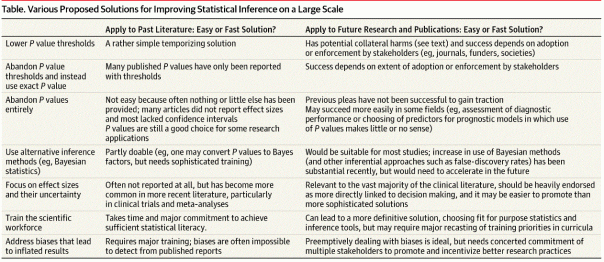
A Summary of Proposals to Improve Statistical Inference
In a recent comment published in the Journal of the American Medical Association, John Ioannidis provided the following summary of proposals (see table below). The summary, and his brief commentary, may be of interest to readers of TRN.


You must be logged in to post a comment.