Every week for 9 weeks you can hear leaders in research transparency talk about their latest thinking on how to make statistical research open, reproducible, and credible. To learn more, see the schedule below and click on each speaker to learn details.
The webcasts are sponsored by Project TIER and will be streamed every Friday at 1:00 pm (Eastern Standard Time, USA), from February 7 through April 3.
Registration is free, but you need to register to access the live stream.
More information and a link to registration can be found here.
SCHEDULE:
|
2/7/20
|
|
To Be Announced
|
2/14/20
|
|
Statistically Valid Inferences from Privacy Protected Data
|
2/21/20
|
|
Checking Robustness in 4 Steps
|
2/28/20
|
|
Falsifying Predictions in Practice
|
3/6/20
|
|
A Computing Workflow for Reproducible Results
|
3/13/20
|
|
Why Scientific Reasoning is Hard: The Role of Cognitive Constraints in Biasing Our Reasoning
|
3/20/20
|
|
Replication and Reproducibility in Social Sciences and Statistics: Context, Concerns, and Concrete Measures
|
3/27/20
|
|
The Importance of Reproducibility in High-Throughput Biology: Case Studies in Forensic Bioinformatics
|
4/3/20
|
|
Promoting Research and Transparency and Reproducibility Through Capacity-Building Trainings Across Sub Saharan Africa and Europe: Lessons Learned and Way Forward.
|
Replication is important. Many journals in economics, including Energy Economics, now insist on papers being published together with a replication package, and a few journals check that package prior to publication. This is a world apart from the common practice only a decade ago. However, the step change in replicability did not lead to a step change in replication.
Energy Economics has therefore published a special issue on replication. We particularly invited replication of older but prominent research, that is, papers that are frequently cited or used in policy making. This type of paper asks whether the old results stand up if newer data are added and methods are brought up to date, and if not why.
We also invited encompassing papers, taking a number of recent articles to check whether the results still hold if all the evidence is put together, comparing results across methods and data sets. No such papers were submitted to the special issue. Energy Economics now has “replication paper” as a new type of submission.
Fifty-seven papers were submitted to the special issue, of which twenty-four were accepted. One author of a replicated paper submitted a comment. Most rejections were because the paper did not add much beyond a replication. The referees, unfamiliar with replication papers, to a person drew a clear distinction between a replication paper that confirms the technical competence of the original authors and a replication paper that adds value.
Six of the twenty-three replications were unsuccessful. The relatively high success rate may be because energy economics is a mature field, and a modest one were few people chase headlines.
Two papers stand out. Jeffrey Racine’s paper reviews software tools that integrate data, analysis, and writing, so as to minimize errors and ensure internal consistency. Bruns and Koenig wrote a pre-replication plan and invited the author of the replicated paper, Stern, to join in the replication. In the resulting paper, they emphasize the importance of the pre-analysis plan to maximise objectivity and minimize conflict.
The special issue demonstrates that there is a supply of replication papers. Serious scholars are prepared to make the time and effort to take a piece of previous research, check whether it withstands scrutiny, and report their findings in a constructive and respectful manner. The special issue also shows that referees are able to tell quality and worthwhile replications from ones that are less so. It is too early to say whether these replication papers are cited and count towards promotion. Finally, the special issue reveals that publishers too can be moved towards replication.
To check out the special issue on replication at Energy Economics, click here.
Richard Tol is a professor of economics at the University of Sussex and professor of the economics of climate change at the Vrije Universiteit Amsterdam. He is Editor-in-Chief at Energy Economics.
[Excerpts taken from the article, “Blocking the Hype‐Hypocrisy‐Falsification‐Fakery Pathway is Needed to Safeguard Science”, by Henning Hopf, Stephen Matlin, Goverdhan Mehta, and Alain Krief, published in Angewandte Chemie International Edition]
“Hype has become prevalent in the age of instantaneous mass communication…there are several drivers.”
“One has been the increasing pressure on academic scientists to demonstrate the “quality”, “value” and “impact” of their work…through metrics that focus on the mechanical surveying of statistics related to the number of publications, their rates of citation and the “impact factors” of the journals in which they are published.”
“To understand how seriously misguided this approach is, one needs to look no further than the cases of Peter Higgs (Nobel Laureate 2013 for the theoretical discovery of the Higgs Boson), who would not have had a scientific career if his publication rate had been taken into account…”
“This pressure was building throughout the 20th century as science expanded, became better funded and increasingly competitive at all levels.”
“It was boosted by the advent of the digital age and by the growing influence of commercial publishers, with intensifying competition among commercial and learned society publishers for a share of the lucrative, expanding market for science journals.”
“Further pressure came from increasing competition between academic centres to enhance their reputations and income by efforts to recruit and retain leading scientists.”
“…the intersection of the science advancement system (via publications), the career reward system (status, promotions, grants and prizes) and the financial system (large profits from publishing journals) has created perverse incentives for authors, publishers…and institutions to game the publishing system to their own advantage.”
“Academic institutions have added to the hype generated between authors and journals by establishing and expanding press and “development” offices that seek to attract attention in the popular media by producing press releases, e-newsletters and website pages summarising the research and its significance…”
“It is but another step down from the grey hinterland of hype into the dark underworld of deliberate falsification.”
“Journals, scientists, institutions and funders all have a part in tackling reproducibility.”
“Many institutions have acceded (at least on paper) to the Declaration on Research Assessment (DORA),…while continuing to turn a blind eye to committees that persist in giving weight to publication metrics such as h-indices and impact factors in assessing academics for employment or promotion.”
“Leading national academies…and individual scientists… have recommended good practices in the evaluation of researchers and research programmes, emphasising the importance of assessment by competent experts rather than reliance on publication metrics.”
“The worlds of science publication, career rewards and commercial interests are tightly interconnected.”
“Finding solutions that will discourage, detect and penalise those who travel along the hype-hypocrisy-falsification-fakery pathway must therefore involve systemic approaches that consider how changes in one part of the system will impact on other parts.”
To read the article, click here.
[Excerpts taken from the article “Ten UK universities create reproducibility-focused senior roles” by Simon Baker, published in Times Higher Education]
“The involvement of 10 universities that have officially joined a UK network set up to tackle the issue of reproducibility in research will be “critical” in making an impact, one of its leaders has said.”
“Institutions including UCL and the universities of Edinburgh, Bristol and Sheffield have signed up to be part of the UK Reproducibility Network, which was established last year in a bid to better coordinate efforts to boost the robustness of research.”
“Each university has created a role that will feature a senior academic leading on practical steps the institution is taking to bolster research quality, such as better training, open data practices and assessing the criteria used in recruitment and promotion decisions.”
“Marcus Munafò, chair of the network and professor of biological psychology at the University of Bristol, told Times Higher Education that the official involvement of universities provided a vital “middle” layer between funders and academics in the drive to tackle the issue.”
“Having institutions on board would also allow them to develop a consistent approach towards policies that can shift research culture away from practices that hamper reproducibility and transparency, Professor Munafò said.”
To read the article, click here.
[Excerpts taken from the article “A consensus-based transparency checklist” by Balazs Aczel and many, many others, published in Nature Human Behavior]
“Ideally, science is characterized by a ‘show me’ norm, meaning that claims should be based on observations that are reported transparently…”
“How can scientists increase the transparency of their work?”
“We provide a consensus-based, comprehensive transparency checklist that behavioural and social science researchers can use to improve and document the transparency of their research…”
“Responses to the checklist items can be submitted along with a manuscript, providing reviewers, editors and, eventually, readers with critical information about the research process necessary to evaluate the robustness of a finding.”
“The initial set of items was evaluated by 45 behavioural and social science journal editors-in-chief and associate editors, as well as 18 open-science advocates.”
“The Transparency Checklist was iteratively modified by deleting, adding and rewording the items until a sufficiently high level of acceptability and consensus were reached and no strong counter arguments for single items were made…”
“The final version of the Transparency Checklist 1.0 contains 36 items that cover four components of a study: preregistration; methods; results and discussion; and data, code and materials availability. For each item, authors select the appropriate answer from prespecified options.”
“It is important to emphasize that none of the responses on the checklist is a priori good or bad and that the transparency report provides researchers the opportunity to explain their choices at the end of each section.”
“In addition to the full checklist, we provide a shortened 12-item version (Fig. 1). By reducing the demands on researchers’ time to a minimum, the shortened list may facilitate broader adoption, especially among journals that intend to promote transparency but are reluctant to ask authors to complete a 36-item list.”
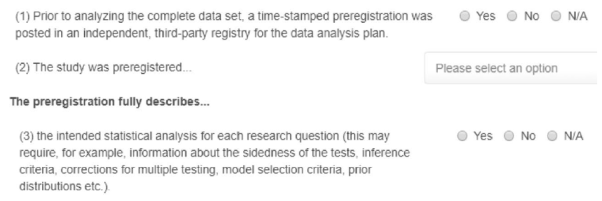

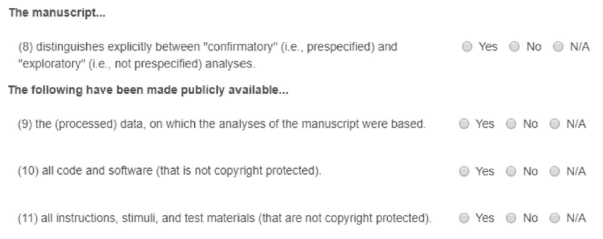

“We created online applications for the two checklists that allow users to complete the form and generate a report that they can submit with their manuscript and/or post to a public repository…”
“The checklist is subject to continual improvement, and we encourage researchers, funding agencies and journals to provide feedback and recommendations.”
To read the article, click here.
[Excerpts taken from the article “Crowdsourcing hypothesis tests: Making transparent how design choices shape research results” by Justin Landy and many others, posted at the preprint repository at the University of Essex]
“…we introduce a crowdsourced approach to hypothesis testing. In the crowdsourcing initiative reported here, up to 13 research teams (out of a total of 15 teams) independently created stimuli to address the same five research questions, while fully blind to one another’s approaches, and to the original methods and the direction of the original results.”
“The original hypotheses, which were all unpublished at the time the project began, dealt with topics including moral judgment, negotiations, and implicit cognition.”
“Rather than varying features of the same basic design…we had different researchers design distinct studies to test the same research questions…”
“The five research questions were gathered by emailing colleagues conducting research in the area of moral judgment and asking if they had initial evidence for an effect that they would like to volunteer for crowdsourced testing by other research groups.”
“We identified five directional hypotheses in the areas of moral judgment, negotiation, and implicit cognition, each of which had been supported by one then unpublished study.”
“A subset of the project coordinators…recruited 15 teams of researchers through their professional networks to independently design materials to test each hypothesis.”
“…materials designers were provided with the nondirectional versions of the five hypotheses presented in Table 1, and developed materials to test each hypothesis independently of the other teams.”

“…our primary focus is on dispersion in effect sizes across different study designs.”
“The diversity in effect size estimates from different study designs created to test the same theoretical ideas constitute the primary output of this project. For Hypotheses 1-4, the effect sizes were independent-groups Cohen’s ds, and for Hypothesis 5, they were Pearson rs.”
“Effect size estimates…were calculated… using…random-effects meta-analyses…This model treats each observed effect size yi as a function of the average true effect size μ, between-study variability, ui ∼ N(0, τ2), and sampling error, ei ∼ N(0, vi)…yi = μ + ui + ei.”
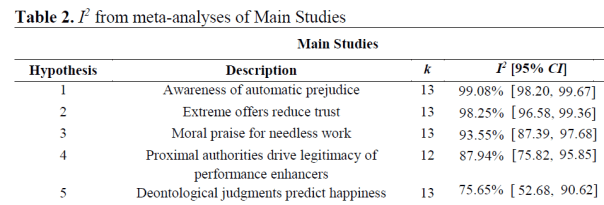
“The I2 statistic quantifies the percentage of variance among effect sizes attributable to heterogeneity, rather than sampling variance. By convention, I2 values of 25%, 50%, and 75% indicate low, moderate, and high levels of unexplained heterogeneity, respectively.”
“All five hypotheses showed statistically significant and high levels of heterogeneity… The vast majority of observed variance across effect sizes in both studies is unexplained heterogeneity.”
Discussion
“How contingent is support for scientific hypotheses on the subjective choices that researchers make when designing studies?… In this crowdsourced project, when up to 13 independent research teams designed their own studies to test five original research questions, variability in observed effect sizes proved dramatic…”
“…different research teams designed studies that returned statistically significant effects in opposing directions for the same research question for four out of five hypotheses in the Main Studies…”
“Even the most consistently supported original hypotheses still exhibited a wide range of effect sizes, with the smallest range being d = -0.37 to d = 0.26…”
“…a number of aspects of our approach may have led to artificial homogeneity in study designs.”
“In particular, materials designers were restricted to creating simple experiments with a self-reported dependent measure that could be run online in five minutes or less.”
“Further, the key statistical test of the hypothesis had to be a simple comparison between two conditions (for Hypotheses 1-4), or a Pearson correlation (for Hypothesis 5).”
“Full thirty-minute- to hour-long-laboratory paradigms with factorial designs, research confederates, and more complex manipulations and outcome measures (e.g., behavioral measures) contain far more researcher choice points and may be associated with even greater heterogeneity in research results…”
“…one cannot generalize the present results to all hypotheses in all subfields…further initiatives to crowdsource hypothesis tests are needed before drawing definitive conclusions about the impact of subjective researcher choices on empirical outcomes.”
To read the article, click here.
[Excerpts taken from the article, “We’re All ‘P-Hacking’ Now” by Christie Aschwanden, publised in Wired]
“It’s got an entry in the Urban Dictionary, been discussed on Last Week Tonight with John Oliver, scored a wink from Cards Against Humanity, and now it’s been featured in a clue on the TV game show Jeopardy. Metascience nerds rejoice! The term p-hacking has gone mainstream.”
“Journals generally prefer to publish statistically significant results, so scientists have incentives to select ways of parsing and analyzing their data that produce a p-value under 0.05. That’s p-hacking.”
“Psychologists Uri Simonsohn, Joseph Simmons, and Leif Nelson elegantly demonstrated the problem in what is now a classic paper. “False-Positive Psychology,” published in 2011, used well-accepted methods in the field to show that the act of listening to the Beatles song “When I’m Sixty-Four” could take a year and a half off someone’s age.”
“It all started over dinner at a conference where a group of researchers was discussing some findings they found difficult to believe. Afterward, Simonsohn, Simmons, and Nelson decided to see how easy it would be to reverse-engineer an impossible result with a p-value of less than 0.05. “We started brainstorming—if we wanted to show an effect that isn’t true, how would you run a study to get that result without faking anything?” Simonsohn told me.”
“They produced their absurd conclusion by exploiting what they called “researcher degrees of freedom”: the little decisions that scientists make as they’re designing a study and collecting and analyzing data.”
“The problem, as the Beatles song experiment showed, is that this kind of fiddling around allows researchers to manipulate their study conditions until they get the answer that they want…”
“A year later, the team went public with its new and better name for this phenomenon. At a psychology conference in 2012, Simonsohn gave a talk in which he used the term p-hacking for the first time.”
“’We needed a shorter word to describe [this set of behaviors], and p-dash-something seemed to make sense,’ Simmons says. ‘P-hacking was definitely a better term than ‘researcher degrees of freedom’ because you could use it as a noun or an adjective.'”
“The phrase made its formal debut in a paper the team published in 2014, where they wrote ‘p-hacking can allow researchers to get most studies to reveal significant relationships between truly unrelated variables.'”
As a wider conversation about reproducibility spread through the field of psychology, rival ways of describing p-hacking and related issues gained attention too. Columbia University statistician Andrew Gelman had used the term “the garden of forking paths” to describe the array of choices that researchers can select from when they’re embarking on a study analysis.”
“‘People say p-hacking and it sounds like someone’s cheating,” Gelman says. “The flip side is that people know they didn’t cheat, so they don’t think they did anything wrong…'”
“Simmons is sympathetic to this criticism. “We probably didn’t think enough about the connotations of the word ‘hacking,’ which implies intentions,” he says. ‘It sounds worse than we wanted it to.'”
“Still, there’s something indisputably appealing about the term p-hacking. “You can’t say that someone got their data and garden-of-forking-pathed it,” Nelson adds. ‘We wanted to make it into a single action term.'”
“The fact that p-hacking has now spread out of science and into pop culture could indicate a watershed moment in the public understanding of science, and a growing awareness that studies can’t always be taken at face value. But it’s hard to know exactly how the term is being understood at large.”
“In a perfect world, the wider public would understand that p-hacking refers not to some lousy tendency or lazy habit particular to researchers, but one that’s present everywhere. We all p-hack, to some extent, every time we set out to understand the evidence in the world around us. If there’s a takeaway here, it’s that science is hard—and sometimes our human foibles make it even harder.”
To read the article, click here.
[Excerpts taken from the article, “The Value of Preregistration for Psychological Science: A Conceptual Analysis”, by Daniël Lakens, posted at PsyArXiv Preprints]
“With the rise of the internet it has become feasible to create online registries that ask researchers to specify their research design, data collection, and the planned analyses…it is useful to evaluate whether and when it is worth preregistering your study.”
“It is…important to justify the value of preregistration based on a philosophy of science. Discussing preregistration without discussing philosophy of science is a waste of time.”
“Preregistration has the goal to allow others to transparently evaluate the capacity of a test to falsify a prediction.”
“Researchers can have many goals that are unrelated to tests of predictions, and in those cases, preregistration might have positive externalities, but it does not serve a goal that can’t be achieved through other means.”
“Mayo (1996) carefully develops arguments for the role that prediction plays in science and arrives at an error statistical philosophy based on a severity requirement: We build a body of knowledge based on claims that have passed a severe test.”
“A test is severe when it is highly capable of demonstrating a claim is false. If a researcher randomly assigns participants to a control and experimental condition, uses a response scale from 1 to 7 to measure how people feel, and claims the difference between the groups will be at most 6 scale points, there is no way for this claim to be proven false. The observed difference must be between zero and six.”
“Figure 1A visualizes a null hypothesis test, where only one specific state of the world (namely an effect of exactly zero) will falsify our prediction.”
“Figure 1B represents a one-sided null-hypothesis test, where differences larger than zero are predicted, and the prediction is falsified when the difference is either equal to zero, or smaller than zero.”
“Figure 1C visualized a range prediction where only differences between 0.5 and 2.5 support the prediction. Since there are many more ways this prediction could be wrong, it is an even more severe test.”


“If we observe a difference of 1.5, with a 95% confidence interval from 1 to 2, all three predictions are confirmed with an alpha level of 0.05, but the prediction in Figure 1C has passed the most severe test since it was confirmed in a test that had a higher capacity of demonstrating the prediction is false.”
“Note that the three tests differ in severity even when they are tested with the same Type 1 error rate.”
“…a preregistration document should give us all the information that allows future readers to evaluate the severity of the test. Researchers should also specify when they will conclude their prediction is not supported.”
“Preregistration adds value for people who, based on their philosophy of science, increase their trust in claims that are supported by severe tests and predictive successes.”
“But researchers often have other goals such as developing measures, descriptive investigations, exploratory studies, and theoretical studies such as mathematical models or simulation studies (de Groot, 1969). In these cases, other philosophies of science might provide a better description of the goal scientists have.”
“…I personally feel that the discussion about preregistration in the psychological literature has often been unproductive, exactly because positive externalities were not separated from the goal of preregistering a study.”
“Preregistration requires researchers to carefully think through their analyses before collecting the data. This can lead to useful improvements when designing a study, but this goal can also be achieved by careful thought.”
“Working through a checklist for a preregistration might remind researchers to think about issues they would otherwise have forgotten, but the study is improved regardless of whether their answers on this checklist is made public.”
“Preregistration is a tool, and researchers who use it should do so because they have a goal that preregistration facilitates. If the use of a tool is detached from a philosophy of science it risks becoming a heuristic.”
“Researchers should not choose to preregister because it has become a new norm, but they should preregister because they can justify based on their philosophy of science how preregistration supports their goals.”
To read the article, click here.
IREE is a young journal, started in 2017. Richard Easterlin and Jeffrey Wooldridge serve on the journal’s Advisory Board. It has already attracted prestigious authors including David Roodman, Joachin Wagner, David Jaeger, Theodore Joyce, Robert Kaestner, and François Roubaud. A recent replication study of research by Crépon, Devoto, Duflo, and Parienté received much attention with the awarding of the Nobel Prize in Economics to Esther Duflo.
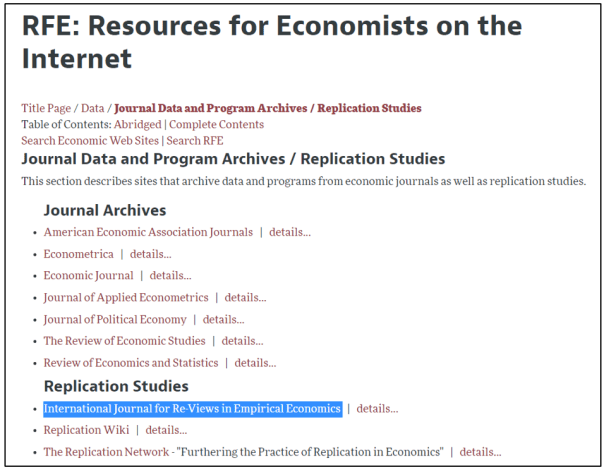
IREE is the only journal in economics completely devoted to replications. It is listed on the AEA’s Resources for Economists on the Internet under “Replication Studies” (see below).
A key element of IREE’s mission is to publish high quality replications regardless of the outcome. That is, both successful and failed replication attempts are welcome. All that matters is that the research is an honest and competent attempt to verify the correctness, robustness, and generalizability of single empirical findings.
Topics of replicated studies may be within Microeconomics, Macroeconomics, Experimental Economics, Finance, and Management. IREE also accepts replication studies from adjacent disciplines that are closely related to economics.
Guidelines for authors are posted here. Key items include:
– Replicators need to have informed the original authors about the replication prior to submission.
– In the case of a failed replication, replicators should make a good faith effort with the original authors to reconcile any discrepancies. A copy of the correspondence should be kept and provided upon request from the journal.
– Replicators are required to submit their data and programming code along with their manuscript for review. Upon acceptance, the data and code will be permanently stored in a publicly accessible data archive.
IREE is an e-journal and articles are published continuously. Publications are instantly available at IREE’s website and distributed via EconStor and RePEc’s EconPapers and IDEAS. All article are open access and there are no publishing fees.
To see a list of replication studies published by IREE, click here.
Finally, should you want a quick assessment if your replication study is appropriate for IREE, you can contact the managing editor, Martina Grunow, iree@zbw.eu.
To learn more about the journal, click here.
The bottom line is this: If you or your students are considering publishing a replication study, consider IREE!
Confidence intervals get top billing as the alternative to significance. But beware: confidence intervals rely on the same math as significance and share the same shortcominings. Confidence intervals don’t tell where the true effect lies even probabilistically. What they do is delimit a range of true effects that are broadly consistent with the observed effect.
Confidence intervals, like p-values and power, imagine we’re repeating a study an infinite number of times, drawing a different sample each time from the same population. Though unnatural for basic, exploratory research, it’s a useful mathematical trick that let’s us define the concept of sampling distribution – the distribution of expected results – which in turn is the basis for many common stats. The math is the same across the board; I’ll start with a pedantic explanation of p-values, then generalize the terminology a bit, and use the new terminology to explain confidence intervals.
Recall that the (two-sided) p-value for an observed effect dobs is the probability of getting a result as or more extreme than dobs under the null. “Under the null” means we assume the population effect size dpop=0. In math terms, the p-value for dobs is the tail probability of the sampling distribution – the area under the curve beyond dobs – times 2 to account for the two sides. Recall further that we declare a result to be significant and reject the null when the tail probability is so low that we deem it implausible that dobs came from the null sampling distribution.
Figure 1a shows a histogram of simulated data overlaid with the sampling distribution for sample size n=40 and dpop=0. I color the sampling distribution by p-value, switching from blue to red at the conventional significance cutoff of p=0.05. The studies are simple two group difference-of-mean studies with equal sample size and standard deviation, and the effect size statistic is standardized difference (aka Cohen’s d). The line at dobs=0.5 falls in the red indicating that we deem the null hypothesis implausible and reject it.
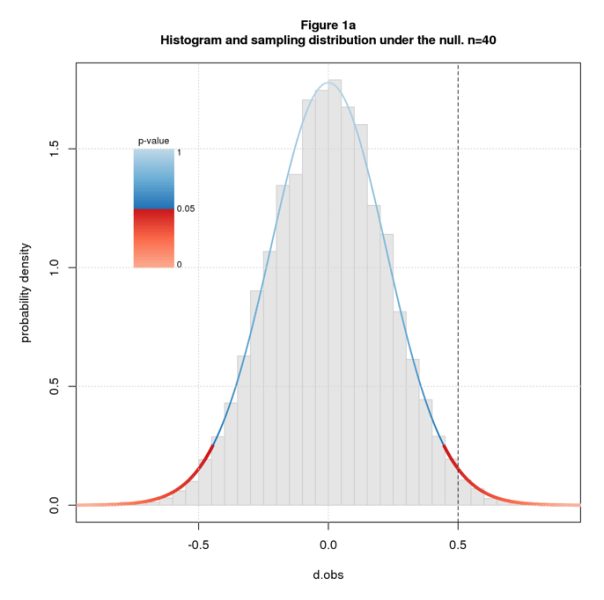

Figure 1b shows sampling distributions for n=40 and several values of dpop. The coloring, analogous to Figure 1a, indicates how plausible we deem dobs given n and dpop. The definition of “plausibility value” (plaus) is the same as p-value but for arbitrary dpop. dobs=0.5 is in the red for the outer values of dpop but in the blue for the inner ones. This means we deem dobs=0.5 implausible for the outer values of dpop but plausible for the inner ones. The transition from implausible to plausible happens somewhere between dpop=0 and 0.1; the transition back happens between 0.9 and 1.
Plausibility is a function of three parameters: n, dpop, and dobs. We can compute and plot plaus-values for any combination of the three parameters.
Figure 2a plots plaus vs. dpop for dobs=0.5 and several values of n. The figure also shows the limits of plausible dpops at points of interest. As with significance, we can declare “plausibility” at thresholds other than 0.05. From the figure, we see that the limits gets tighter as we increase n or the plausibility cutoff. For n=40 and the usual 0.05 cutoff, the limits are wide: [0.5, 0.94]. For n=400 and a stringent cutoff of 0.5, the limits are narrow: [0.45,0.55]. This makes perfect sense: (1) all things being equal, bigger samples have greater certainty; (2) a higher cutoff means we demand more certainty before deeming a result plausible, ie, we require that dpop be closer to dobs.
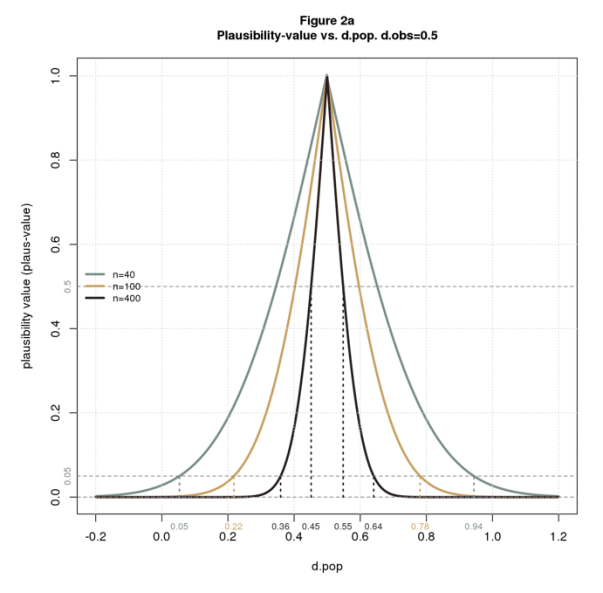

The plausibility limits in Figure 2a are consistent with Figure 1b. Both figures say that with n=40 and dobs=0.5, dpop must be a little more than 0 and a little less than 1 to deem the solution plausible.
Now I’ll translate back to standard confidence interval terminology: confidence level is 1 – plaus usually stated as a percentage; confidence intervals are plausibility limits expressed in terms of confidence levels. Figure 2b restates 2a using the standard terminology. It’s the same but upside down. This type of plot is called a consonance curve.
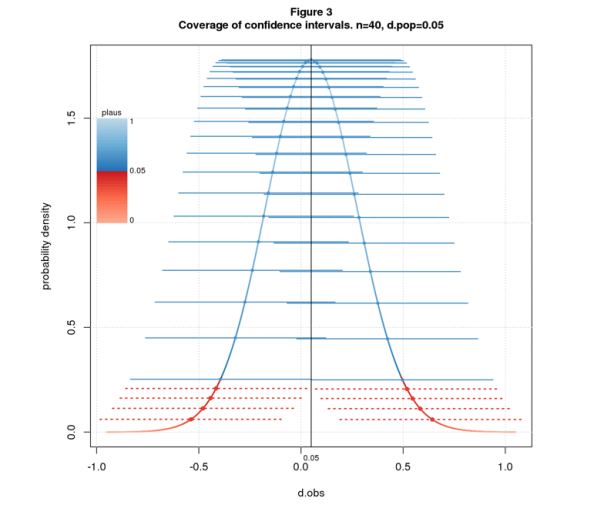
A further property of confidence intervals, called the coverage property, states that if we repeatedly sample from a fixed dpop and compute the C% confidence intervals, C% of the intervals will contain dpop. Figure 3 illustrates the property for 95% confidence intervals, n=40, and dpop=0.05. The figure shows the sampling distribution colored by plaus-value, and confidence intervals as solid blue or dashed red lines depending on whether the interval covers dpop. I arrange the intervals along the sampling distribution for visual separation.
Many texts use the coverage property as the definition of confidence interval and plausibility limits as a derived property. This points the reader in the wrong direction: since C% of intervals cover dpop, it’s natural to believe there’s a C% chance that the interval computed from an observed effect size contains dpop. This inference is invalid: the interval delimits the range of dpops that are close enough to dobs to be deemed plausible. This says nothing about probability.
Stats likes strong words: “significance”, “power”, “confidence”. Words matter: “significant” suggests important; “power” suggests the ability to get the right answer; “95% confidence” suggests we’re pretty darn sure; “95% confidence interval” and “95% of intervals cover dpop” suggest a 95% chance that the true effect falls in the interval. None of these inferences are valid.
Statistics is fundamentally about uncertainty. Why hide this behind the smog of strong words? There’s no surefire way to prevent the misuse of statistics, but better language can only help. Words that scream “weak and uncertain” – words like “plausible” – are a step in the right direction.
COMMENTS PLEASE!
Nat Goodman is a retired computer scientist living in Seattle Washington. His working years were split between mainstream CS and bioinformatics and orthogonally between academia and industry. As a retiree, he’s working on whatever interests him, stopping from time-to-time to write papers and posts on aspects that might interest others.

 The Replication Network
You must be logged in to post a comment.